

Mozilla's decline is now unstoppable. Last year I wrote about how political correctness was replacing technical excellence as the goal, and last week's events shattered all my hopes that things would change.
I'll make my usual clarification. This isn't a post for or against any particular politician. It's a post in support of the principles on which this website was founded.
Mrs. Baker's Ministry of Truth
Mitchell Baker is the president of the Mozilla Foundation and the CEO of its commercial arm, the Mozilla Corporation. On the Foundation's official blog, she wrote:
… Of course, the question of when a head of state should be banned is a critical one, among many others that must be addressed. When should platforms make these decisions? Is that decision-making power only yours?
So far so good. Except for one detail. Platforms shouldn't be able to permanently ban anyone until a judge authorizes it.
But as reprehensible as Donald Trump's actions are, the rampant use of the internet to foment violence and hatred and reinforce white supremacy is about more than just a personality. Donald Trump is certainly not the first politician to exploit the architecture of the Internet in this way, and he will not be the last. We need solutions that don't start after untold damage has been done.
Note that Mrs. Baker says nothing about the black tweeters calling for violent retaliatory actions against whites or the hateful message from women who consider every heterosexual male to be a rapist.
Your post continues
Changing these dangerous dynamics requires more than just the temporary silencing or permanent removal of bad actors from social media platforms.
Additional precise and specific actions must also be taken:
Let's see what those measurements are.
- Inform who pays for the ads, how much they pay and to whom they are directed.
- Make the platform's algorithms public so that you know how and what content is being amplified, to whom, and the associated impact.
- Activate by default the tools that warn about false information.
- Work with independent researchers in the study of the impact of platforms on people and our societies.
I know of a couple of dictatorships who were sure to approve of Mrs. Mitchell's "transparency measures." On the other hand, what is the criterion to determine that something is false?
I had a crazy idea. What if we better educate people so that they know how to distinguish it for themselves?
The decline of Mozilla And how are we doing at home?
So far, Baker's ideas may be debatable, albeit well-intentioned. But let 's take a look at the work he's paid for with Google's generous contributions to the Foundation.
In the overall market, it comfortably ranks third behind Chrome and Apple
Chrome: 63,38%
Safari: 19.25 %
Firefox: 3.77 %
The newcomer Edge already has 3.08 %
In the growing mobile device market, things are even worse. On both tablets and mobile phones, Firefox is the least used browser, with less than 1% market share.
Well, you say. At least Mrs. Baker will be great with her employees. Let's see:
Not only did it manage to lay off 250 employees during the pandemic (while internet usage was growing), but it also announced a restructuring that made no mention of reducing executive compensation . This is a graph showing the evolution of executive compensation and market share in 2018.
To end. a minor detail, but one that illustrates the double discourse.
Last year they posted this:
Facebook has a big problem with hate speech and misinformation on its platform. Despite groups calling on him to take action, including Mozilla, he has yet to make changes.
But Facebook has an Achilles heel: 99% of its $ 70 billion in revenue comes from advertisers.
We're calling on Mozilla's peers - tech companies and companies heavily reliant on the Internet for their core business - who are among the top Facebook advertisers to get their ads off Facebook including Amazon, Uber, Samsung, Disney, and Apple.
We need your help to encourage them to join the growing movement against hate speech and misinformation online. Can you tweet telling companies to join #StopHateForProfit?
Take a look at the screenshot of their latest newsletter.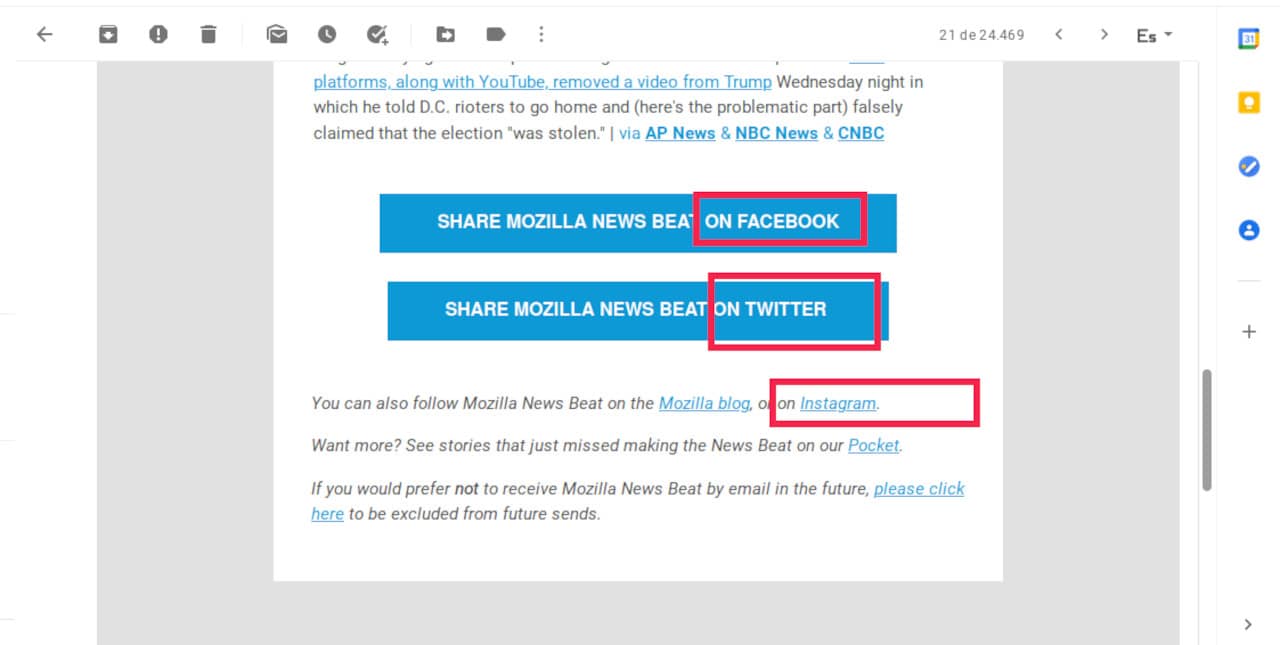
While launching a campaign to boycott democratically elected presidents (whether we like them or not), the Mozilla Foundation proposes measures that would allow dictatorships to persecute opponents . While complaining about social media, they encourage their users to use it and are careful not to promote the use of open-source alternatives that guarantee privacy and net neutrality.
Of course, from the looks of it, neither of the two things interest Mozilla anymore.
Table of Contents