
Yesterday, as I mentioned before, I had the immense fortune of attending Richard M. Stallman's talk in the city of Mar del Plata.

Although he gave two talks, one on his own today and the talk yesterday that was contained within the ITU-T Kaleidoscope Conference: Innovations for Digital Inclusion organized by the ITU (International Telecommunication Union).
Why see him in this talk and not the other one? Two reasons: the organizers of the other talk really took their time deciding on the venue and time (but we're not going to discuss unrelated organizational issues here) and because the ITU talk had a very interesting ingredient: Stallman wasn't in his element.
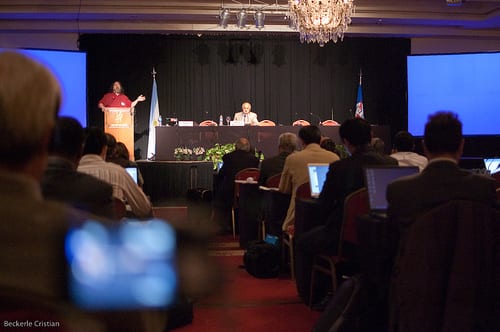
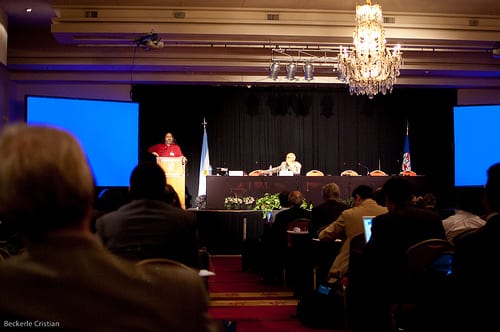
What do I mean by Stallman not being in his element? I mean that there were no GNU/Linux user groups present at this talk . There were no people who knew the difference between GNOME and KDE , and they probably weren't aware of the FSF , licenses, proprietary packages, or anything like that. Absolutely nothing.
The title of the session in which RMS was presented as a guest was called Is digital inclusion a good thing? where the topics that we always discuss in this space in one way or another were addressed.
* Control of our information on the web , hand in hand with the privacy and freedoms we have as users;
* Software as a service , which in his opinion is a terrible thing, since in addition to not being able to access the code, we don't even have the executable;
* Proprietary Software and how it restricts our obvious and natural freedoms regarding what we would do with our property (sharing it, copying it, changing it to our liking, etc.);
* Free Software as an alternative to Proprietary Software ;
* Implementation possibilities of Free Software versus Proprietary Software.
Reading the topic, you will realize that we are always talking about the same thing; the topic of the talk is the one that has been previously presented and that, if you remember, renateitor had told us on another occasion.
My conclusions
From where I was located, you could perfectly see the notebooks of those attending the talk. If the good RMS had asked to turn around and show the notebooks, surely he would have been very bitter, since practically all had Windows, and some other, Mac OSX. The part of the talk dedicated to asking questions was very, very juicy, because the attendees asked the same questions that we all asked ourselves when we decided to start using free software:
* How do I know there's no malicious code, backdoors, or bugs in free software?
Who controls free software?
* How do I apply patents, licenses, and so on? We already know that too much freedom is counterproductive; there is no such thing as complete lack of control.
* Why change the way I do things for a more time-consuming and inefficient method? This question was truly incredible. The IBM representative couldn't understand why RMS would do something differently than the suggested method, especially since it would take more time, and RMS didn't understand what he meant by inefficient. They ended up closing the discussion with a very unconvincing "...OK..." from the IBM representative.
* All this you're saying sounds very nice in theory, but to me it sounds a bit communist . I must say, honestly, when that gentleman called you a communist in front of everyone else, my heart stopped. RMS smiled, adjusted his hair, and replied as best he could that if we all know communism has failed miserably and that free software aims to defend the individual freedoms of software users, then this could in no way be related to communism. Simple, sharp, and clear.
That was the last question ( thank goodness, who knows what they would have come up with after that ), and after the obligatory applause, I got the impression that while everyone was applauding, no one was actually convinced by what RMS was saying. Not even a little.
A battle (in my opinion) lost.
The change is in the generations to come. Let us aim to establish the teaching of free software in schools, from the most basic levels. I see no other way to change a thought as ingrained as the one that was evident in that talk.

I look forward to your comments on this. For my part, I'll leave you with the immense joy of meeting Richard M. Stallman in person and the profound pride I felt realizing that, while I'm not a die-hard free software user, I'm not so narrow-minded that I couldn't see that this man was talking about something possible, not an unattainable utopia. One step closer to truly owning my PC. I'm getting closer every day…
What do you all say? Is digital inclusion a good thing?
Regards!
P.S. The models in the photo are @marceloalegre and me, and the excellent images belong to Cristian Beckerle, who gave me permission to use them. A huge hug and an equally huge thank you.