

Much is coming to KDE in the next few months. The desktop environment will be upgraded to Plasma 6, and the team met in Germany to discuss how to implement this change. There will be many modifications, some more popular than others, but part of the goal is to improve the stability of the second most used desktop environment in Linux, as well as to make everything look better after booting an operating system with KDE software for the first time.
This was announced by Nate Graham, who also publishes weekly articles about the new features they're working on, in a post titled "Better Defaults." KDE met at the offices of Tuxedo Computers, one of their sponsors, and began discussing their vision for the future . One of their key changes is to release fewer versions, a point that may be more popular with some than with others.
The future of KDE starts with Plasma 6
Graham confirms that he already uses Plasma 6 by default and expects to continue doing so until the stable version is released. Regarding new features, there will be changes to some default settings. In Plasma 6, opening files and folders will be done with a double-click, not a single click. Most of the KDE team prefers a single click, but users and different platforms typically use two, so switching to two clicks will make things easier for those who decide to switch to KDE. I've always used double-click, but that's because that's how the distributions I've used have implemented it. Naturally, this change will take effect after a clean installation, and you can revert to single-click by changing it in System Preferences.
The next point they addressed is a bit more frightening: Wayland by default . Why is it frightening if I've been using it for weeks ? Well, it still needs a lot of polishing. If I use it myself and run into problems, it's my responsibility; if they change it and problems arise, it's their responsibility. And they have a lot of work ahead of them. Right now, in some WordPress fields where something is set by default, I've had to refresh the page twice to remove that element and manually enter what I wanted.
But KDE promises to work hard and make things different. So no one has to worry, the X11 session will still be available (as GNOME does), and many of the bugs are from third parties, so they believe it's up to them to improve their software.
Other default settings in Plasma 6
The floating panel will be enabled by default in Plasma 6. I think they'll have to refine it a bit more to make it more consistent, because the reason I'm not using it is that things aren't quite working together. Kickoff, that is, the application launcher, stays on the edge "without floating," and I think that should be different. Also, when it hides, sometimes it doesn't do so from the bottom edge, but from a few millimeters higher (the gap between the floating panel and the bottom edge), and this doesn't give a good impression.
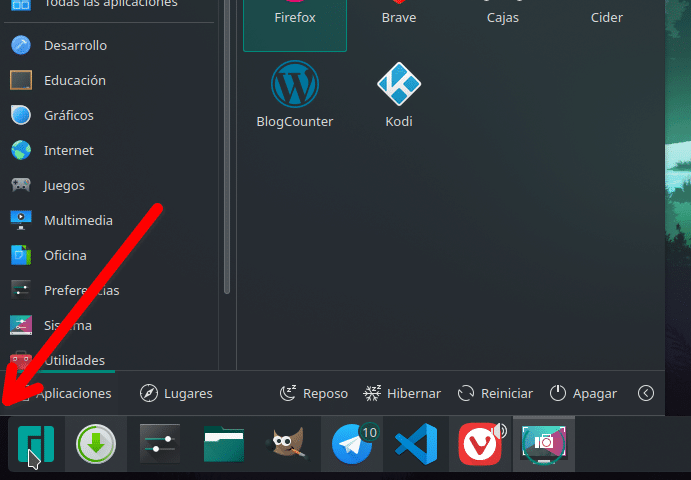
One of the reasons for making this change is that although Windows 11 was based on KDE, people say that KDE copied Microsoft, and putting the floating panel will make a very identifiable difference.
There will also be changes to the accent color . By default, the top bars will use that color. They've released a sample, but it's a mockup, and to be honest, since they used a color similar to the light theme, I barely notice any difference.
New application switcher (Task Switcher), removed gestures...
The application switcher is something I've personally never used much, neither in Windows, nor Mac OS X (I haven't used macOS), nor in Linux, but I do occasionally use the keyboard shortcut. I have to say that the default one in Plasma isn't the prettiest, and I've changed it to the option that displays applications in a cascade. KDE won't be using that, but they will change it to what's shown in the following image:
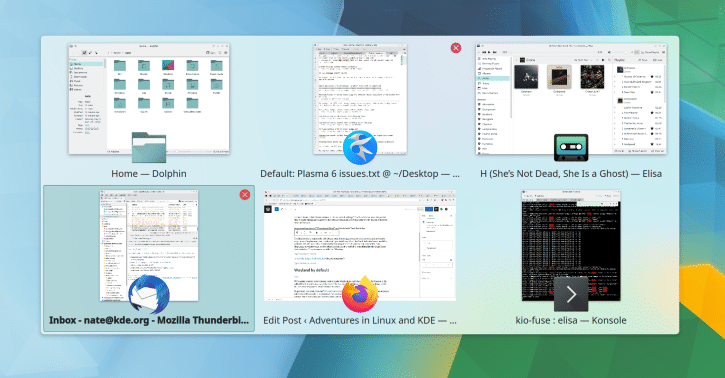
The current system uses a bar that extends from the left edge and scrolls down through the apps as you press Tab (while holding Alt). KDE plans to use a grid layout, displaying "cards" below the icons, and also stacking them vertically in a grid . Along the way, they'll remove other options they say are rarely used; pray they don't remove your favorite one.
I must confess that I didn't understand the next change they want to make, and I had to go into the linked task to get some clarity. The change is that they're going to remove the ability to switch desktops by scrolling with the mouse wheel or using two fingers on the touchpad, a gesture also known as scrolling . I was worried they were going to remove one of the gestures I use most often, which is switching between desktops by sliding three fingers on the touchpad, but what they're actually removing is the option to switch desktops by sliding two fingers on the virtual desktops icon in the bottom panel.
It's better explained in the linked task and makes perfect sense: swiping on the volume and turning it up or down makes sense; do the same on the desks, no. It can happen that it moves by accident, we go to a completely empty window and we don't know what happened or how to get back to where we were. This can happen to all of us, but especially to the less experienced.
Also related to scrolling, KDE will introduce a change where clicking on the scroll bar will jump directly to that point . The previous behavior can be reverted to in the settings.
Two KDE Plasma releases per year
KDE has matured considerably in the last eight years. While KDE 4 wasn't entirely successful, and while KDE 5 significantly improved reliability and added numerous enhancements, everything now seems to be in its right place. There's no longer a need to release three versions per year, let alone the four that were previously released, and they will now release two Plasma versions annually.
This will not apply to the first changes, but when they believe they have reached a certain stability. It will give more time to get things ready, and it will also allow distros that release two versions a year to use the latest version of Plasma. GNOME releases two versions a year, and both Ubuntu and Fedora add the latest in April and October. If they do the same with Plasma, Kubuntu and Fedora in their KDE edition, they will never have to use something "old".
Plasma 6.0 will arrive alongside Qt6 and Frameworks 6.0 in the second half of 2023. In the meantime, 5.27 is what's available now, and it will continue to receive updates as an LTS release.
Images and content: Nate Graham.
Table of Contents