
It took a long time for me to have an internet connection at home, and for years my only contact with the internet (although I always liked it a lot and it was useful to me) was either school or the cybercafé.
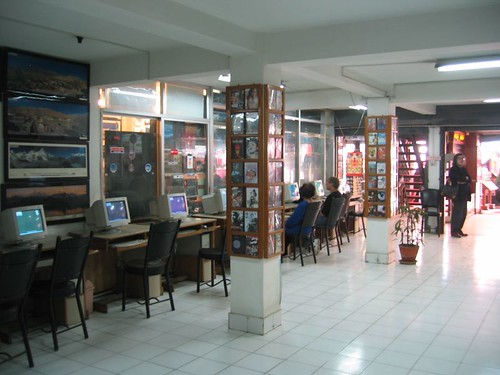
Interestingly, despite the massive internet penetration of today, internet cafes, far from dying out, are multiplying , now fulfilling (on their own scale) the function of public telephones. But those of us who frequented these places in the past, and still do, know that they have things that make us uncomfortable and that we wouldn't experience at home.
Sometimes I go to an internet cafe because I'm out and about, and even though I use WAP a lot, it's not enough for what I need to do, or it makes it very inconvenient. I ask for a PC, sit down, and plug in the USB drive with Firefox Portable , which helps me keep all the sites I frequent at hand. I start typing and realize it's slow. It doesn't matter which internet cafe I go to; it's Windows, and I feel out of place. I do what I need to do, and every now and then an error pops up. That depends on how well-maintained the place is. I hear someone about three desks away say, "Excuse me, but this PC won't connect." I don't hear any more; I have to leave. I take out my USB drive, pay, and leave.
Since I have Linux, I go into the home PC and immediately see the viruses on the device and delete them. If I hadn't had Linux the infection was safe. In the best of cases, the infection occurred in one out of every two visits to an internet café.
I suppose all this takes away time, quality of life, and ultimately money from the owners of these establishments. Why not use Linux and end the mess once and for all?
A cybercafé with Linux seems like a good idea, but it has a couple of problems :
The first of these problems is that it is clearly feared that new customers will be spooked by an unusable platform, which could be impossible to learn in an hour (and sometimes less). Imagining only this many would abandon the idea immediately, but why not camouflage Windows so that people do not feel surprised. If at first we try and people do not want to learn, it would be better to make them believe that Linux is Windows XP.
With the exception of the players (who I will talk about below), people come to do simple things on a cyber like go to the photoblog, check Facebook, chat on MSN and some with GTalk (the least) and surf. It also happens that people are received who have to print curricula or school assignments made with Word.
You do not have to be an expert to determine that all this can be done with Linux, with whatever distro. There are only a couple of things that can cause difficulty:
1.- Know how to access the pendrive and the local folder (the / home) where the files are downloaded or where the OpenOffice files are going to be saved.
2.- That the programs are objectively different, although they fulfill the same tasks.
But all of that can be fixed :
1. There are themes for GNOME and KDE that perfectly resemble Windows XP (including the Teletubbies background ). XPGNOME even goes so far as to trick the user by explicitly telling them they are still in Windows and providing easy access to folders. While the KDE theme I found isn't quite that convincing, KDE Looks offers an alternative that makes KDE look like Windows Vista.
2.- Choose the messaging client that we are going to use for each PC deserves special attention, it has to be as friendly as possible with whoever uses the original MSN. The aMSN It is the most similar to the original and with the aMSN2 project they are working to make it even better and faster.
Another case is that of Microsoft Word that while it is replaceable by OpenOffice, more than ever produces format exchange drawbacks that can annoy a customer. With cross over linux It would not even be necessary to go through that dilemma.
Linux-based internet cafe management software is also available, such as CBM, which has a Linux version. Cyborg is another option.
And what about gamers?
Before writing this article I was arguing with Esty, she told me that everything I said was not worth it because internet cafes are for gamers and I started crying. I replied that Wine could make a difference.
The famous Call of Duty , in its version 4, works on Linux; the cybercafé owner would simply have to make it boot directly with Wine after following these steps to install it.
It is just an example, all the other games are a matter of googling "name of the game + Linux" how they are installed and simply run.
Finally, here's a video of the internet cafe that did manage it :
See also : CiberLinux, the GNU/Linux distribution for internet cafes
The image belongs to shinyai who graciously gives it to LXA! everyone under Creative Commons